Griezelige vallei betekenis
De term "uncanny valley" is uitgevonden door de Japanse roboticaprofessor Masahiro Mori als Bukimi no Tani Genshō (不気味の谷現象) in [1] De theorie van Mori wordt in verband gebracht met het in door Ernst Jentsch ontwikkelde concept van het "griezelige" en zijn essay met de titel "Zur Psychologie des Unheimlichen", vrij vertaald als: "Over de psychologie van het griezelige". Als dat zo is, heb je het fenomeen ervaren dat bekend staat als de griezelige vallei. Voor het eerst voorgesteld in door de Japanse roboticus Masahiro Mori, is de griezelige vallei het griezelige, weerzinwekkende gevoel dat we krijgen als we een entiteit observeren die er bijna menselijk uitziet, maar een essentieel element van. Griezelige vallei betekenis De griezelige vallei is een boeiend psychologisch fenomeen dat de manier waarop we humanoïde robots, animaties en computer-gegenereerde beelden (CGI) De griezelige vallei - Dataconomy NL The uncanny valley refers to the discomfort felt toward humanoid representations that closely resemble real humans but fall short of authenticity.



Uncanny valley definitie
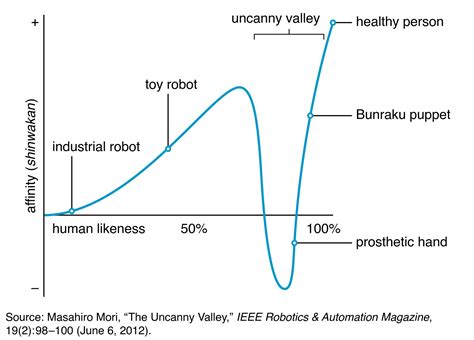
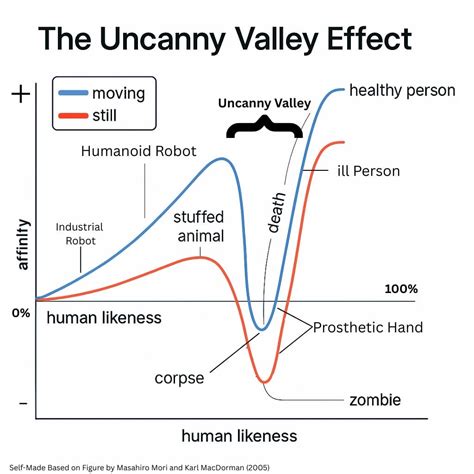
The uncanny valley (Japanese: 不気味の谷, Hepburn: bukimi no tani) effect is a hypothesized psychological and aesthetic relation between an object's degree of resemblance to a human being and the emotional response to the object. The uncanny valley hypothesis predicts that an entity appearing almost human will risk eliciting eerie feelings. Uncanny valley, theorized relation between the human likeness of an object and a viewer’s affinity toward it. The hypothesis originated in a essay by Japanese roboticist Masahiro Mori, in which he proposed that as human likeness increases in an object’s design, so does one’s affinity for the. Uncanny valley definitie The uncanny valley is a theory in aesthetics suggesting a humanoid object appearing almost, but not exactly, like a real human can evoke feelings of eeriness or revulsion, rather than familiarity, due to the object's proximity to reality yet noticeable imperfections.Uncanny valley effect
The uncanny valley is the region of negative emotional response towards robots that seem "almost" human. Learn about the concept, its origin, its hypothesized psychological and aesthetic relation, and its applications in robotics, animation and artificial intelligence. Learn about the uncanny valley, a phenomenon that makes humanoid objects or robots that look almost human appear creepy or disgusting. Explore the origin, history, examples, effects, theory, and research of this concept in aesthetics and robotics. Uncanny valley effect The uncanny valley is a phenomenon where human likeness in an object or image creates a feeling of eeriness or uncanniness. Learn about the theory, its origin, and its applications in robotics, film, and the sciences.Griezelige vallei robotica
☀ Het griezelige vallei-essay, oorspronkelijk geschreven door masahiro mori, krijgt meer dan 40 jaar later een nieuwe, volledige vertaling. The uncanny valley (Japanese: 不気味の谷, Hepburn: bukimi no tani) effect is a hypothesized psychological and aesthetic relation between an object's degree of resemblance to a human being and the emotional response to the object.- Griezelige vallei robotica Voor het eerst voorgesteld in door de Japanse roboticus Masahiro Mori, is de griezelige vallei het griezelige, weerzinwekkende gevoel dat we krijgen als we een entiteit observeren die er bijna menselijk uitziet, maar een essentieel element van menselijkheid mist.